The Real Cost
Wealth inequality is not an abstraction. It kills people. It traps children in poverty. It forces workers into impossible choices. These are the human stakes.
One Death Every Four Seconds
Inequality contributes to the death of at least one person every four seconds globally. By the time you read this paragraph, someone has died from a condition that adequate resources could have prevented. [8]
22 Empty Homes Per Homeless Person
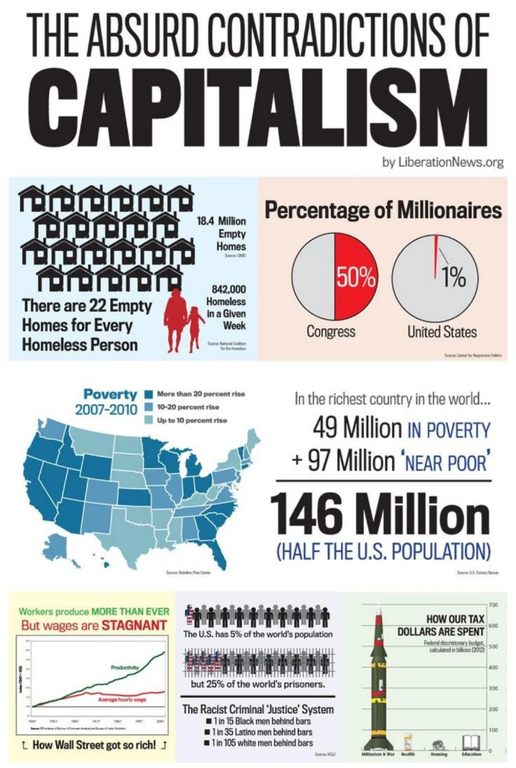
There are 18.4 million empty homes in the United States. There are 842,000 people experiencing homelessness in a given week. That is 22 empty homes for every person without one. [15] This is not a housing shortage. It is a distribution failure.
146 Million in or Near Poverty
In the world's richest country, 49 million people live in poverty and 97 million more are "near poor" — one crisis away from falling below the line. That is roughly half the U.S. population. [16]
Workers Are Told to Live Within Their Means
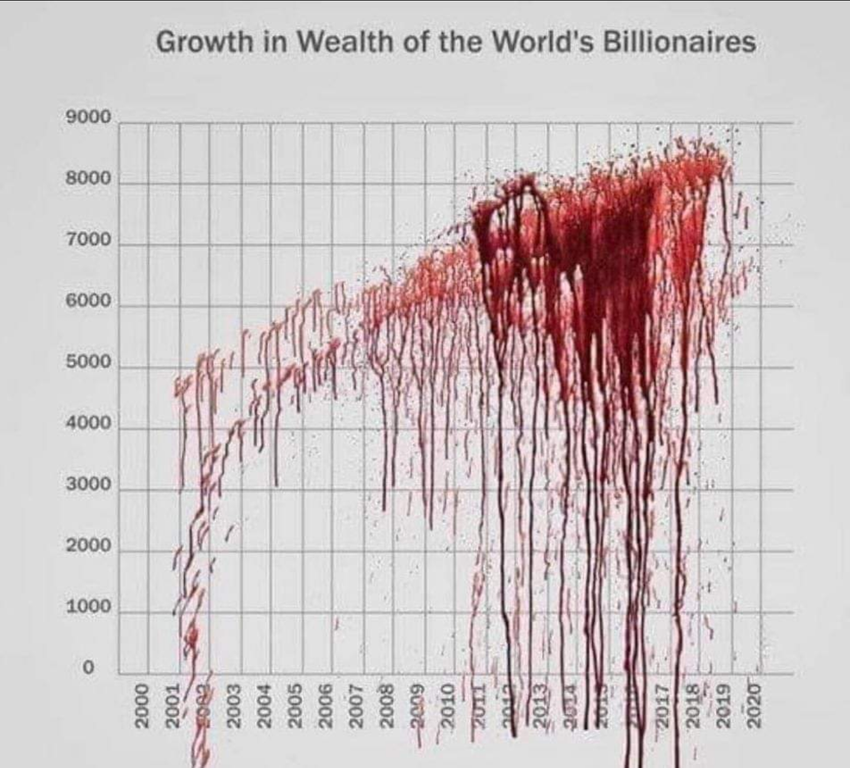
More than 50% of Americans earn less than $30,000 per year. Meanwhile, Jeff Bezos accumulated the equivalent of $142,667 per minute at the peak of his wealth growth. [11] It is workers — not oligarchs — who are told they're living beyond their means.
Productivity Divorced from Pay
Workers produce more than ever. Wages have barely moved. The gap between productivity gains and worker compensation — what Wall Street captured for itself — is the story of the last 50 years. [2]
The Exploitation Button
There is a well-known moral dilemma: push a button, receive $1 million, but someone you don't know dies. Most people wouldn't push it. What isn't discussed is that this is exactly what exploitation does — and every billionaire is pressing that button as many times as they can, all the time, because that's how capital accumulation works.
Your Regulations Are Written in Blood
A federal worker health and safety inspector described her training this way: when she and her classmates were laughing at the seemingly obvious level of specificity in the Code of Federal Regulations — rules like "no hazardous material shall be stored in crew berthing" — her instructor stopped them cold with a single sentence:
"Your regulations are written in blood."
That rule about hazardous materials and crew quarters wasn't written on a whim. It was written because someone decided they could cut costs by storing radioactive, toxic, or carcinogenic materials in the same rooms where the workers paid to transport those materials slept — and they did it, because no one had told them not to. And people died. Horrifically.
This is the pattern behind every safety regulation that gets called "job-killing red tape." Not bureaucratic overreach. Someone's death, written into law so it wouldn't happen again.
— @themightyglamazon, federal health and safety enforcement officer
The Pattern Repeats
Every generation produces its own version of this calculation — the moment when a company decides that the cost of a fix is greater than the cost of the deaths. Sometimes it's explicit. Sometimes it's just the market working exactly as advertised.
Ford Pinto, 1970s. Ford's engineers identified a fuel tank design that caused fires in rear-end collisions. An internal memo calculated that paying wrongful death settlements would be cheaper than the $11-per-car fix. Ford chose the settlements. People burned.
GM ignition switch, 2000s. A defective switch could cut engine power mid-drive and disable airbags. The fix cost 57 cents per car. GM sat on the knowledge for over a decade. At least 124 people died. The cost-benefit math had been done, and the 57 cents had lost.
Boeing 737 MAX, 2018–19. Boeing lobbied for reduced FAA oversight and was permitted to self-certify key safety systems. Engineers rushed the MCAS flight control software to meet a delivery schedule. Two planes crashed. 346 people died. Boeing's stock recovered.
Triangle Shirtwaist Factory, 1911. Factory owners locked the exits to prevent workers from taking unauthorized breaks. A fire broke out. 146 young women — mostly immigrant garment workers — died because they could not get out. The outrage that followed created New York's first fire codes and early labor protections. The regulation was written, quite literally, in their blood.
In every case: deregulation was framed as freedom. What it actually meant was freedom for the powerful to make decisions that killed the powerless — and to externalize the cost onto their bodies.