How We Got Here
Extreme wealth concentration didn't happen by accident. It was the predictable result of specific policy choices, made over decades, by people who benefited from them — and sold to everyone else as "the natural order."
The Robber Baron Era
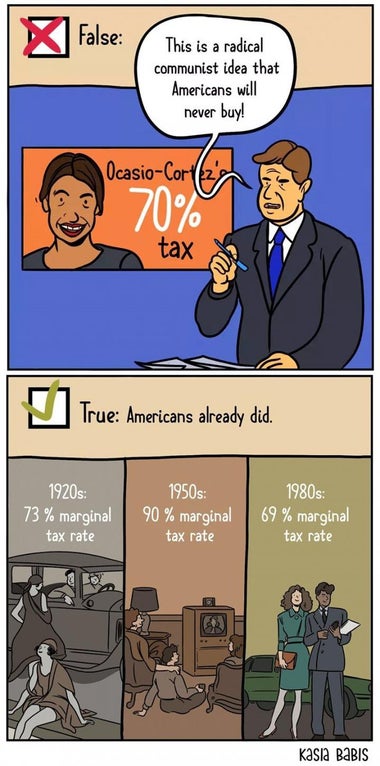
Carnegie, Rockefeller, Vanderbilt, and Astor amass fortunes through monopoly power. The U.S. government eventually responds with antitrust law. The top marginal tax rate reaches 73%. [6]
The Golden Era of the Middle Class
Top marginal income tax rate hits 90%. CEO-to-worker pay ratio: roughly 20:1. Unions cover one in three workers. Broad prosperity is the result. [6]
The Friedman Doctrine
Economist Milton Friedman publishes his landmark New York Times essay declaring that a corporation's sole social responsibility is to increase profits for its shareholders. This "shareholder supremacy" doctrine — that executives owe nothing to workers, communities, or the public — becomes the ideological blueprint for the next half-century of corporate governance, justifying mass layoffs, union-busting, and the relentless extraction of wealth from labour to capital. [6]
The Reagan Revolution
Top marginal rate drops to 28%. "Trickle-down" economics becomes policy. Unions weaken. The CEO-to-worker pay gap begins its 40-year climb. The top marginal rate settles at 69% before the cuts. [6]
Citizens United
The Supreme Court rules that political spending is protected free speech, allowing unlimited corporate and billionaire money to flood elections. [7]
Pandemic Acceleration
The world's billionaires doubled their fortunes during the COVID-19 pandemic, from $700 billion to $1.5 trillion, while millions lost jobs and livelihoods. [8]
We've Had High Tax Rates Before — And It Worked
The argument that high marginal tax rates on the wealthy are "radical" or "communist" collapses when you look at American history. The U.S. economy boomed during the very decades when the top marginal rates were highest.
The Monopoly Game Analogy
Did you know the board game Monopoly was originally designed to teach children the inherent dangers of capitalism? It was derived from "The Landlord's Game," patented in 1904 by Elizabeth Magie — intended as a warning, not a celebration.
In a famous Stanford study, researchers gave one player two dice and the other only one. The "wealthier" player passed Go more often, accumulated advantages, and won. When asked afterward why they won, not one rich player mentioned the dice. They attributed their success entirely to skill and smart decisions. [9]
"It can get people who are winning at the game of life to think about their resources as things that they deserve — and as a result, to be less willing to do things about inequality."— Paul Piff, psychologist, Stanford University [9]
Capital vs. Labor
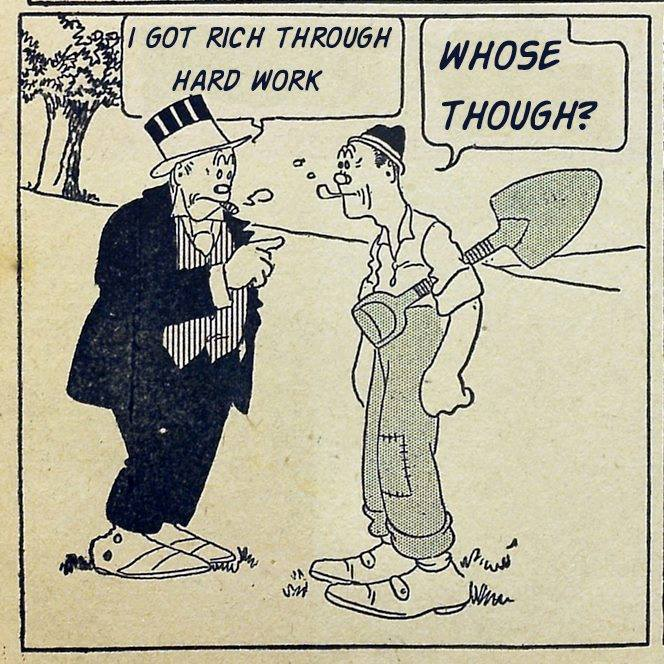
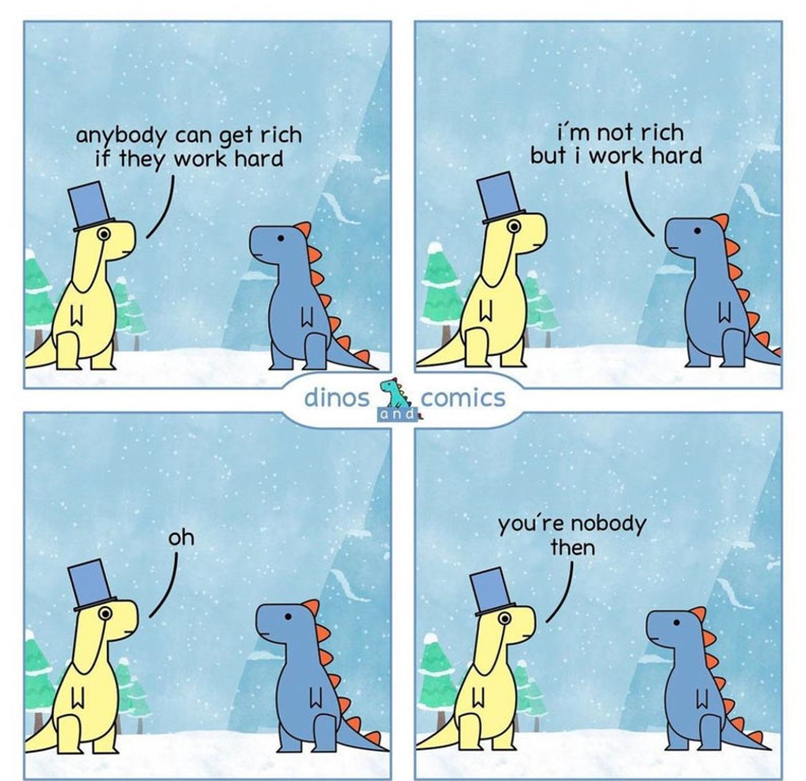
Every dollar a billionaire accumulates beyond what a reasonable salary would produce is surplus value extracted from the people who did the work. No individual creates a billion dollars of value. It is always a collective effort, with one person positioned by law, capital, and inherited advantage to capture the proceeds.
Mansa Musa. Carnegie, Rockefeller, Vanderbilt, Astor. Zuckerberg, Musk, Bezos. Every era has its billionaires. Every era has its workers who built the wealth and received a fraction of it.