Debunking the Myths
The billionaire class has spent considerable resources promoting a particular story about how wealth works. Here are the most common claims — and why they don't hold up.
"They earned that money. They deserve it."
No individual earns a billion dollars. No single person creates that much value. Billionaire wealth is the result of capturing the collective output of thousands of workers — legally, but not equitably.
As Oxfam notes: 44% of all billionaires inherited their wealth. [10] Of the rest, many benefited from public infrastructure, publicly funded research, government contracts, and legal protections created by the collective.
Elon Musk increased his fortune by $36 billion in a single day in 2020 — roughly the GDP of Nepal. Did he work harder than the entire population of Nepal that day? [3]
"Anyone can get rich if they work hard enough."
More than 50% of Americans earn less than $30,000 per year. [11] These are not lazy people. They are workers in an economy that has systematically redirected the gains of productivity to the top.
CEO pay has risen 937% since 1978. Worker pay has risen 5.7% in that same period. The gap is not explained by effort. It is explained by power — who has it and who doesn't. [2]
When your boss's income has risen 937% since 1978 and yours has increased by only 5.7%, the problem is not that you're not working hard enough.
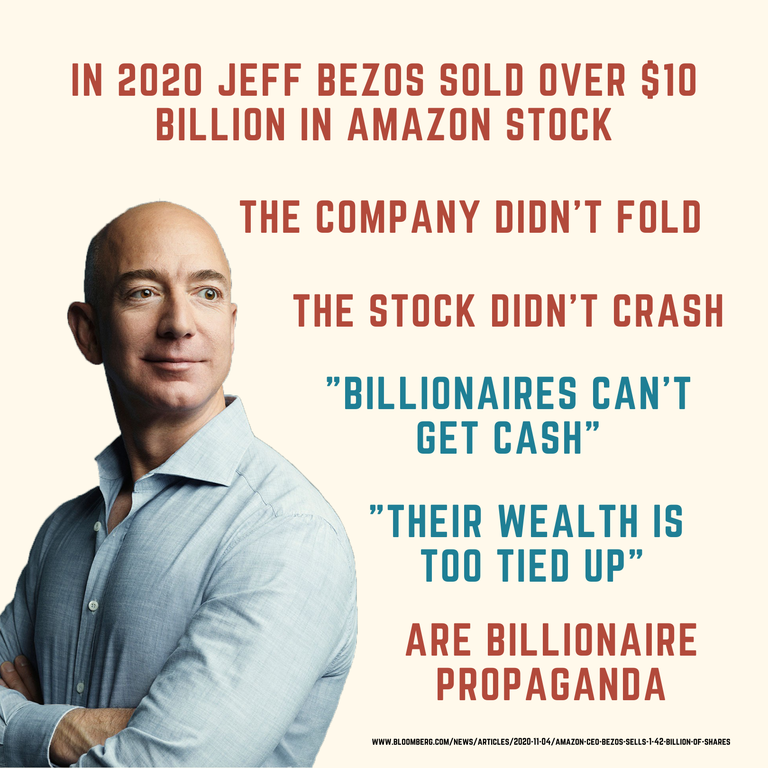
"Their wealth is just on paper — they can't access it."
In 2020, Jeff Bezos sold over $10 billion in Amazon stock. [12] Amazon didn't fold. The stock didn't crash. Bezos remained one of the wealthiest people in the world.
The claim that "billionaires can't get cash" is a talking point designed to deflect tax discussions. In practice, billionaires borrow against their stock holdings at low interest rates — receiving cash without triggering taxable income events. It is how Elon Musk paid $0 in federal income taxes in 2018. [13]
"Taxing billionaires is radical communism."
The United States had top marginal income tax rates of 73% in the 1920s, 90% in the 1950s, and 69% in the early 1980s. [6] These were not communist periods. They were periods of broad prosperity, a growing middle class, and strong economic growth.
In 1933, Congress considered a constitutional amendment limiting personal wealth to $1 million. It never left committee — but it illustrates that what sounds radical today was a mainstream policy conversation less than a century ago. [14]
A 70% top marginal rate — like the one proposed by Rep. Alexandria Ocasio-Cortez — would only apply to income above a certain threshold. It would not affect anyone earning less than roughly $10 million per year.
"Some billionaires are generous — they give it away."
Yes, some billionaires — Chuck Feeney, Andrew Carnegie, Yu Pengnian — gave away their vast fortunes while alive. This is admirable. But it does not solve the problem.
Philanthropy is not democracy. When a billionaire funds a school, a hospital, or a cause, they choose which school, which hospital, which cause. No one votes on it. The public has no say. Concentrated wealth translates directly into unaccountable power over what gets resources and what doesn't.
The deeper point is that no one should ever be in that position. The solution to extreme poverty is not to hope that the extremely rich decide to be generous. It is to build systems that don't create that concentration in the first place.